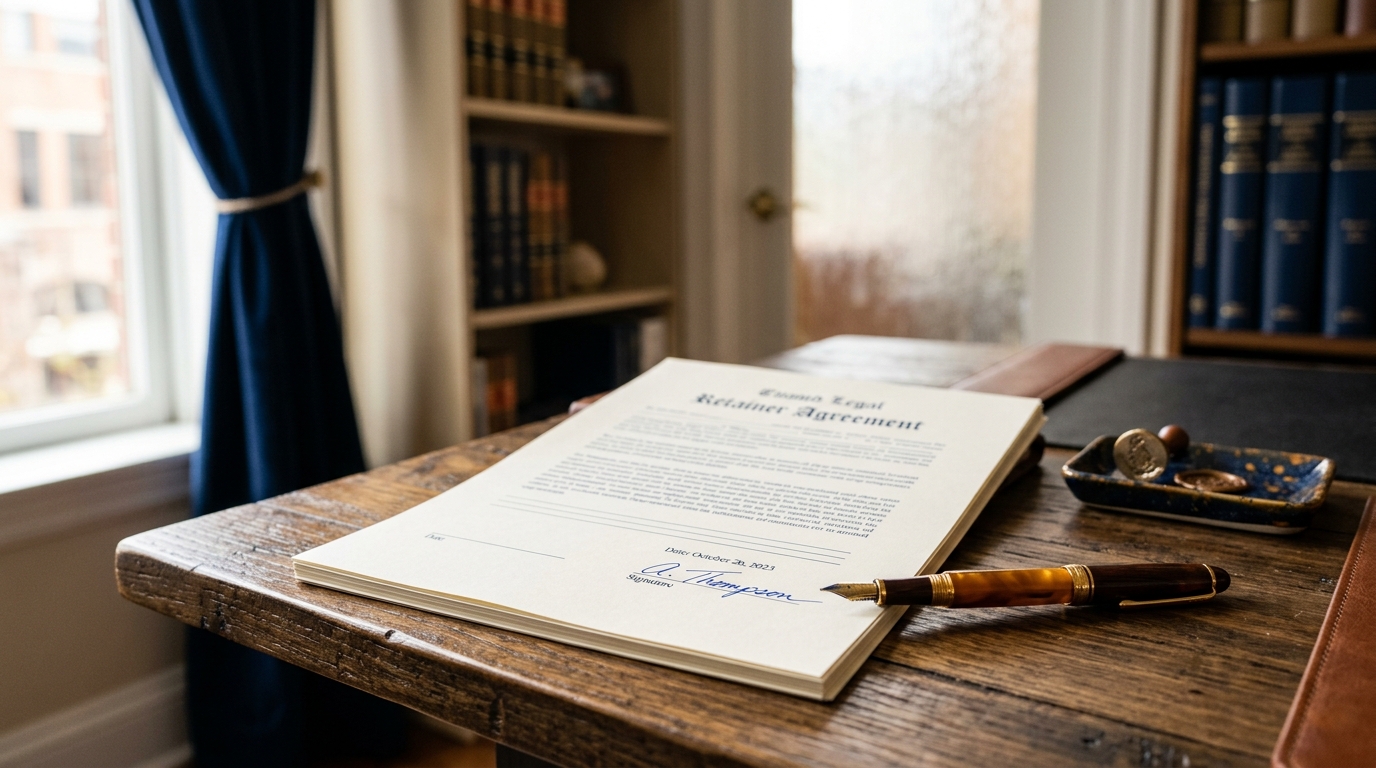
California Business and Professions Code section 6147 governs contingency fee agreements in non-medical-malpractice matters. The statute is short. The compliance consequences for getting it wrong are not. A fee agreement that fails the section 6147 requirements is voidable at the client's election, and a client who voids the agreement is entitled to be defended on a reasonable-fee basis — almost always at a lower number than the contingency would have produced.
The statute has been on the books in its modern form for decades. State Bar discipline involving section 6147 has accelerated in recent years, and plaintiff PI firms are well-advised to audit their retainer-agreement templates against the current statutory requirements rather than relying on whatever the firm started using a decade ago.
What the statute requires
Section 6147 has six core requirements. Every contingency fee agreement in a non-medical-malpractice matter must, to be enforceable, contain each of them.
(1) The contingency fee rate. The agreement must state the rate or rates of the contingent fee that the attorney will charge. A flat-rate agreement (33 1/3 percent of the recovery, for example) is acceptable. A graduated-rate agreement (25 percent pre-suit, 33 1/3 percent post-suit, 40 percent post-appeal) is acceptable. What is not acceptable is an agreement that leaves the rate unstated or contingent on facts not yet known.
(2) How disbursements and costs will be deducted. The agreement must state whether costs and disbursements are deducted from the recovery before or after the contingency fee is calculated. The distinction matters financially. Pre-fee deduction produces a smaller fee on the same gross recovery. Post-fee deduction is more favorable to the attorney. Either is allowed; the agreement must specify which.
(3) What expenses will be deducted. The agreement must identify what categories of expenses will be deducted from the recovery. The category list cannot be open-ended in a way that effectively delegates all cost decisions to the attorney without client consent.
(4) The extent of attorney services covered. The agreement must state what the attorney is being retained to do. A retention for "all matters arising from the accident" is broad but acceptable. A retention worded so vaguely that the client cannot tell what the lawyer is engaged to handle is not.
(5) Statement that the fee is not set by law. The agreement must include a statement, in writing, that the fee is not set by law but is negotiable between attorney and client. This requirement is the one most commonly omitted by older agreement templates. State Bar discipline involving section 6147 violations frequently turns on the absence of this specific language.
(6) Signed duplicate to the client. The agreement must be in writing, signed by the attorney and the client, with a duplicate provided to the client. Electronic signature meets the writing requirement, but the duplicate-delivery requirement must be operational. A client who never receives a copy of the executed retainer has a section 6147 defense available.
The voidability remedy
The most consequential feature of section 6147 is the voidability remedy. Subdivision (b) provides that an agreement that fails the statutory requirements is voidable at the client's option, and that the attorney in such a case is entitled to recover only a reasonable fee for the services provided.
The reasonable-fee fallback is almost always lower than the contingency would have been on a successful PI matter. On a $400,000 recovery with a forty-percent contingency, the contingency fee is $160,000. The reasonable-fee fallback, computed on actual time and a reasonable hourly rate, is typically $40,000 to $90,000 depending on the case profile. The gap is the cost of a defective retainer.
The voidability remedy is available at the client's election, not the firm's. A client who is satisfied with the result and the relationship may never raise the section 6147 issue. A client who is unhappy at closing has a powerful tool to extract concessions, and a successor lawyer entering at the end of a case has the same tool available to compress predecessor counsel's lien.
Where firms get this wrong
Three recurring failure patterns account for most section 6147 disputes in California PI practice:
The legacy template problem. A firm that has been using the same retainer since 2014 is using a retainer that may not include the "fee is not set by law" language, may not address the cost-deduction sequence with adequate specificity, or may not handle electronic-signature workflows in a way that produces a clean duplicate to the client. The fix is a template audit by counsel familiar with the statute. The audit takes an afternoon. The exposure it removes is significant.
The associate-handles-intake gap. Many plaintiff firms have junior staff handle the retainer signing without senior-lawyer review. When the retainer is sent out missing the duplicate-to-client step, or signed in a workflow that does not capture both signatures cleanly, the section 6147 defense becomes available to any disaffected client downstream. The fix is workflow review and intake-side training.
The mid-case modification problem. When a case shifts from pre-suit to suit, or from suit to appeal, and the contingency rate is supposed to step up under a graduated-rate agreement, the agreement language has to handle the transition cleanly. Vague language about "increase to forty percent if the case is appealed" without specifying triggers and notice produces disputes that the client wins under section 6147's strict-construction posture.
The State Bar discipline pattern
Public State Bar Court decisions involving section 6147 over the last several years show a consistent pattern. The discipline outcomes are heavier when the section 6147 violation is combined with other failures (trust accounting violations, communication-related rule violations, inadequate fee disclosure) than when the section 6147 violation is the only issue. But the statute remains the doorway to discipline review on many of these matters, and a clean retainer template removes one of the easiest paths to a disciplinary referral.
The State Bar's posture in 2026 has continued the recent trend toward heavier scrutiny of fee-agreement compliance in plaintiff practice. The discipline rate has not exploded, but the discipline outcomes have gotten more consistent, and the bar's appetite for stipulated discipline on documented section 6147 violations is real.
Audit framework for an existing firm
Plaintiff PI firms reviewing their fee-agreement compliance should run a five-question audit on the current template and intake workflow:
One: Does the agreement state the contingency rate or rates with adequate specificity, including any graduated triggers?
Two: Does the agreement specify whether costs are deducted before or after the fee calculation?
Three: Does the agreement identify the categories of expenses that will be deducted?
Four: Does the agreement include the "fee is not set by law" language, in a form the client cannot reasonably miss?
Five: Does the firm's intake workflow reliably produce a signed duplicate to the client, with documentation of delivery?
A firm answering "yes" to all five has a defensible section 6147 posture. A firm answering "yes" to four or fewer has an action item.
For the firm-finance considerations that frame why retainer-agreement compliance matters as much to working-capital as it does to discipline exposure, see the cash flow piece. For the closely-related vetting question on the provider side of the same case, see the doctor-on-lien vetting checklist.
The closing observation
Section 6147 is the single piece of statutory housekeeping that protects the contingency fee on every plaintiff PI case the firm handles. A firm running its retainer template against the statute once a year, and its intake workflow against the same checklist, is a firm that has removed a meaningful category of professional-responsibility exposure. The work is procedural, the cost is modest, and the protection is durable. The firms that take the time to do it do not have section 6147 problems.